

Introduction: The Enduring Enigma of Soma
At the very heart of the ancient Vedic religion lies Soma, a concept as foundational as it is profoundly enigmatic. Soma is at once a revered deity in the Indo-Aryan pantheon, a physical plant of terrestrial origin, and the sacred, life-altering elixir prepared from it.1 This multifaceted identity makes Soma a unique and complex subject of study. The quest to understand Soma—its scriptural roots, its botanical identity, its ritual function, and its eventual fading from prominence—is not merely an academic exercise; it is a journey into the core of the early Indo-Iranian worldview, revealing its cosmology, its values, and the evolution of its religious consciousness over millennia.2
The central challenge in studying Soma is its refusal to be confined to a single category. It is a god, a substance, and a symbol of immortality and divine awareness, all at the same time.1 This conceptual fluidity is the source of its enduring fascination and the reason for centuries of scholarly debate. This report aims to provide a comprehensive, multi-disciplinary analysis of Soma. It will trace its origins from Proto-Indo-Iranian prehistory, document its apotheosis in the hymns of the Rigveda, explore the intense scholarly search for its physical identity, and analyze its transformation and the reasons for its decline. By integrating textual analysis, archaeological evidence, and the history of religions, this report will illuminate the enduring legacy of the divine elixir of the Vedas.
Part I: The Divine Soma – Scriptural Foundations and Mythology
The Rigveda – The Nectar of the Gods
The primary and most vivid descriptions of Soma are found in the Rigveda, the oldest of the Vedic texts. Here, Soma is not merely an object but a powerful, active agent in the cosmic drama.
The Soma Mandala (Mandala 9)
The Ninth Mandala of the Rigveda is a unique literary monument, comprising 114 hymns singularly devoted to Soma Pavamana, which translates to “Purifying Soma”.1 Unlike other mandalas, which are typically organized by the priestly family or clan of the author, the Soma Mandala is compiled topically.6 This structural choice underscores the supreme importance of the Soma ritual itself in the Vedic world. The hymns capture a specific, dynamic moment in the sacrifice: the pressing of the Soma stalks, the filtering of the raw, tawny juice through a sieve of sheep’s wool, and its subsequent mixing with water or milk before being offered to the gods.1
The Effects of Soma – Immortality and Vision
The consumption of Soma is described as a transformative, ecstatic experience. The most celebrated verse articulating this is Rigveda 8.48.3: “We have drunk the Soma; we have become immortal; we have gone to the light; we have found the gods”.8 This powerful declaration establishes Soma’s primary functions: it is the elixir of immortality (
amrita) and a direct conduit to the divine realm.1 The experience is consistently associated with light, poetic inspiration, a feeling of being set free into boundless space, and a profound sense of power.7 The hymns speak of healing the sick and helping the lame, driving away evil, and granting supreme ecstasy.7
The Nature of Soma’s Power (Máda)
A critical distinction exists between the state induced by Soma, known as máda, and the common intoxication produced by alcoholic beverages like sura.4 The Yajurveda details the effects of
sura as durmadh—a state of drunkenness, confusion, and madness. In stark contrast, Soma’s máda is a state of heightened consciousness, strength, vision, and mental awakening.4 It is this power that invigorates the god Indra for his “great deeds” (RV I.56.1).4 The hymns specify that “drunkards do not praise with their (beer)-sura” (RV VIII.2.12), clearly demarcating the sacred exaltation of Soma from profane inebriation.4 This distinction is fundamental to understanding the ritual’s purpose and is a key point of contention in the later debate over Soma’s botanical identity.
Soma’s Divine Attributes
The hymns personify Soma as a multifaceted and powerful deity. He is hailed as the king of the world, the lord of all plants (Vanaspati), and the essence of life itself.4 As a divine being, Soma is a wise seer (
kavi), a poet who inspires hymns, and a fierce warrior who assists Indra in slaying the wicked and destroying their fortresses.7 He is the cosmic pillar supporting the heavens and the earth, the source of all nourishment and creative energy.7
The Metaphorical Interpretation within the Rigveda
Even within the earliest strata of Vedic literature, there are hints of a more profound, esoteric understanding of Soma. Rigveda 10.85.3-4 introduces a startling ambiguity: “One thinks, when they have brayed the plant, that he hath drunk the Soma’s juice; Of him whom Brahmans truly know as Soma no one ever tastes”.5 This suggests that from a very early period, a distinction was made between the external, physical drink and an internal, spiritual Soma. This inner Soma is a state of consciousness, a divine bliss accessible only to the truly enlightened sage (
Brahman), not to the ordinary ritual participant. This early evidence of a metaphorical interpretation foreshadows the later philosophical developments in the Upanishads.
The Divine Entourage – Soma’s Relationship with the Vedic Pantheon
Soma does not exist in isolation; its identity and function are defined by its crucial relationships with other major deities, particularly Indra and Agni.
Indra, the Foremost Drinker
The relationship between Indra and Soma is symbiotic and central to Rigvedic mythology. Indra is the preeminent deity of the Rigveda, the subject of a quarter of its hymns and the great warrior-king of the gods.1 His cosmic power, however, is not inherent but is directly derived from drinking Soma in vast quantities.1 This sacred drink gives him the strength to perform his primary heroic feat: the slaying of the serpent-demon Vritra, who holds back the cosmic waters. By defeating Vritra, Indra releases the waters, establishes cosmic order (
rita), and brings life and light to the world.1 Indra is the ultimate
somapah (“Soma-drinker”), and the midday pressing (mādhyandinasavana) of the Soma sacrifice is reserved exclusively for him, a testament to their inseparable bond.13
Agni and Soma – A Cosmic Duality
Equally fundamental is the cosmological pairing of Agni (Fire) and Soma. Together, they form the two essential poles of the Vedic sacrifice and, by extension, the universe itself.15 Agni is the ‘eater’ (
annada), the principle of heat, energy, and transformation. As the divine priest and messenger, Agni consumes the offerings and carries their essence to the gods.17 Soma, in this dynamic, is the ‘food’ (
anna), the oblation itself. It represents the principle of substance, nourishment, coolness, and water.15 The entire cosmos is conceptualized as a perpetual
yajna (sacrifice) where Agni consumes Soma, a dynamic interplay that creates and sustains all of existence.15 This polarity of Agni-Soma, fire and water, energy and substance, is a foundational concept in Vedic thought, analogous to the Yin and Yang of Chinese philosophy.20
Soma’s Post-Vedic Transformation – The Lunar Deity
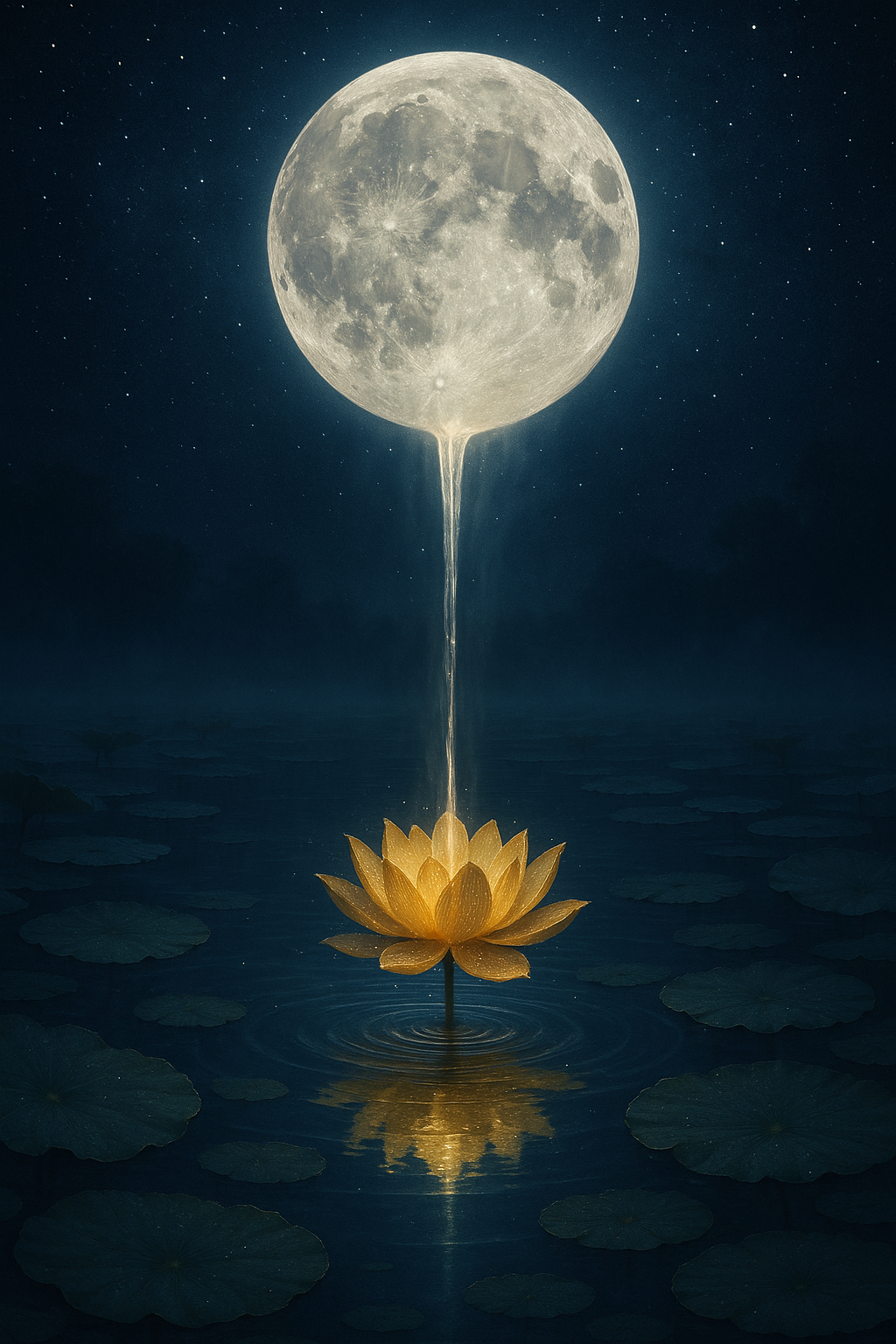
While the earliest hymns focus on Soma as a plant and a drink, its identity evolves over time. In the later portions of the Rigveda and more explicitly in subsequent texts like the Shatapatha Brahmana and the Upanishads, Soma becomes firmly identified with Chandra, the Moon.5 The Brahmanas provide a sophisticated mythological explanation for this connection: the Moon is the celestial vessel of Soma, the food of the gods. As the gods drink from it, the Moon wanes. It is then reborn and replenished through the earthly Soma sacrifice.23 A key part of this myth states that on the new moon night (
amavasya), when the moon is dark, the divine essence of Soma descends to Earth and enters the waters and plants.5 This essence is then gathered through the Soma plant and offered back to the gods in the ritual, completing the cosmic cycle. This elegant cosmology links the celestial realm (the Moon), the terrestrial realm (the plant), the atmospheric realm (rain), and the ritual realm (the sacrifice) into a single, unified system with Soma as the vital, circulating fluid.
Soma in the Later Vedas and Beyond
The portrayal and function of Soma continue to evolve through the later Vedic corpus, reflecting a broader shift in Hindu religious thought.
Samaveda
The Samaveda, or “Veda of Songs,” is a liturgical text whose purpose is to provide the musical framework for the Soma sacrifice.24 Its hymns, known as
Saman, are almost entirely borrowed from the eighth and ninth mandalas of the Rigveda.26 The Samaveda does not introduce new descriptions of Soma; rather, Soma is the very reason for its existence. The chants sung by the
Udgatri priest are set to specific melodies to accompany the pressing and offering of the divine drink, making the ritual an aesthetic as well as a spiritual performance.6
Yajurveda
The Yajurveda, or “Veda of Worship Knowledge,” marks a significant shift from the poetic praise of the Rigveda to the precise, technical codification of ritual.4 This Veda consists of prose mantras and detailed instructions for the
Adhvaryu priest, who orchestrates the physical actions of the sacrifice. It is here that the Somayajna is broken down into its complex components, with specific rules for every action.4 The Yajurveda’s meticulous focus on ritual technology contrasts sharply with the Rigveda’s more spontaneous and experiential hymns, highlighting the increasing formalization of the Vedic religion.
Atharvaveda
In the Atharvaveda, Soma’s role is expanded and integrated into the world of healing, charms, and sacred magic.24 It is invoked as the “foremost” of all medicinal herbs and the divine life-force (
ojas) present in all vegetation.20 The Atharvaveda also introduces a significant theological development by frequently pairing Soma with the god Rudra, a formidable precursor to the Puranic Shiva.28 These “Soma-Rudra” hymns foreshadow the later Shaivite iconography in which Soma is the
amrita that drips from the crescent moon adorning Shiva’s head, linking the Vedic elixir directly to one of the great gods of classical Hinduism.28
Bhagavad Gita
Centuries later, the Bhagavad Gita (Chapter 9, Verse 20) makes a notable reference to “those who drink the juice of the pure Soma plant,” describing them as performers of Vedic sacrifices who seek heavenly rewards.1 This mention demonstrates the enduring memory of the Soma cult but reframes it within a new theological landscape. In the Gita’s view, such ritual action, performed for its fruits, is a lower path than the selfless devotion (
bhakti) to Krishna.
The trajectory of Soma through the scriptures maps a clear evolution in religious thought. It begins in the Rigveda with a direct, ecstatic experience of a divine substance. This is followed by a period of intense ritualization in the Brahmanas and Yajurveda, where correct procedure becomes paramount. The Atharvaveda shows a practical application of Soma’s power for healing and protection. Finally, the Upanishads and later philosophical texts internalize the concept entirely, reinterpreting the external sacrifice as a metaphor for an inner, yogic process. The true Soma becomes a state of divine bliss secreted within the enlightened practitioner’s own consciousness. This progression—from ecstatic experience to ritual codification and finally to philosophical metaphor—represents a classic pattern in the historical development of religious ideas.
Part II: The Earthly Soma – The Quest for a Botanical Identity
While the scriptures paint a vivid picture of Soma’s divine nature and effects, the identity of the physical plant from which it was derived remains one of the greatest unsolved mysteries in the fields of Indology, botany, and the history of religions.3 The quest to identify this plant has spanned over two centuries and has produced more than one hundred proposed candidates, a testament to the ambiguity of the textual descriptions and the evolving scientific and cultural lenses through which researchers have viewed the problem.2 The central axis of this debate revolves around a fundamental question: was Soma a stimulant, intended to heighten awareness for ritual and battle, or was it an entheogen, a psychoactive substance capable of inducing the profound visionary states described in the hymns?.1
| Candidate Plant/Fungus | Primary Proponent(s) | Core Hypothesis | Supporting Evidence | Key Counterarguments & Critiques | |||
| Ephedra spp. (e.g., E. distachya) | Harry Falk, K.F. Kashikar | Stimulant | Linguistic: Cognate Haoma in Iranian languages refers to Ephedra.33 | Ritual: Used by modern Zoroastrians in the Yasna ceremony.33 | Textual: A mountain-dwelling, yellowish, leafless, jointed shrub, matching descriptions.32 | Pharmacology: Contains ephedrine, a stimulant that enhances alertness and prevents sleep, aligning with descriptions of máda.1 | Lacks the powerful hallucinogenic/visionary properties described in the Rigveda.2 Archaeological claims for its presence at BMAC sites are disputed.33 |
| Amanita muscaria (Fly Agaric) | R. Gordon Wasson | Entheogen (Hallucinogen) | Morphology: Texts mention a “cap” and “stem” but no leaves, flowers, or roots, suggesting a fungus.3 | Color: Epithet hari (reddish-yellow) and descriptions of a “white robe” match the mushroom’s cap and veil.3 | Habitat: Grows in mountain regions.11 | Ethnographic Parallel: Use in Siberian shamanism provides a model for its ritual consumption.1 | Effects can be deliriant and unpleasant, not purely ecstatic.37 The lack of detailed plant descriptions is not unique to Soma in the Vedas.37 Considered a depressant by some, unsuitable for warriors.37 |
| Peganum harmala (Syrian Rue) + DMT Plant | David Flattery, Martin Schwartz, Matthew Clark | Entheogen (Ayahuasca Analogue) | Pharmacology: P. harmala contains MAO inhibitors that, when combined with a DMT-containing plant (e.g., Acacia), create a potent oral psychedelic, explaining the visionary effects.2 | Textual: Accounts for the need for complex ritual preparation (mixing ingredients).38 | This is a complex biochemical theory that requires assuming the presence and knowledge of two specific plant types. Direct textual or archaeological proof of the combination is lacking. | ||
| Psilocybe cubensis (Psilocybin Mushroom) | Terence McKenna | Entheogen (Hallucinogen) | Pharmacology: Effects of psilocybin are considered by some to be a better match for the ecstatic visions than Amanita.37 | Textual/Symbolic: Strong association of Soma with cows in the Rigveda aligns with this mushroom’s coprophilic (dung-growing) nature.32 | Less direct textual support for its morphology compared to the Amanita theory. Relies heavily on interpreting the cow symbolism. | ||
| Sarcostemma acidum (Somalata) | Traditional Srauta Brahmins | Substitute | Ritual: It is the plant currently used in the rare Somayajna rituals performed in South India.1 | Linguistic: Known as Somalata (“Soma creeper”) in several Indian languages.31 | Lacks the potent effects described in the Rigveda.35 Its widespread availability contradicts textual accounts of Soma becoming scarce.35 Generally considered a later substitute by most scholars.40 |
The Stimulant Hypothesis – Ephedra
A leading candidate, particularly for the Zoroastrian Haoma, is the Ephedra shrub.32 The case for
Ephedra is built on strong linguistic, ritual, and pharmacological evidence. In modern Iranian languages, the word for Ephedra is often hom or a related term, a direct descendant of the Avestan haoma.33 Crucially, Zoroastrian priests in Iran and their Parsi counterparts in India continue to use
Ephedra in their central Yasna ceremony to this day.34 The plant’s physical description as a yellowish, leafless, mountain-dwelling shrub with jointed stems and a brown pith (
babhru) aligns well with textual accounts.32
Pharmacologically, Ephedra contains the alkaloid ephedrine, a powerful stimulant chemically similar to amphetamine. This fits perfectly with the influential theory advanced by scholar Harry Falk, who argued that the desired effect of Soma/Haoma was not hallucinogenic intoxication but heightened alertness, awareness, and stamina for priests engaged in long rituals and for warriors heading into battle.1 However, the primary critique of the
Ephedra theory is its inability to account for the vivid, visionary, and “immortality”-granting experiences so central to the Rigvedic hymns.2 Its effects are stimulating, not entheogenic.
The Entheogenic Hypothesis – Amanita muscaria
In 1968, the amateur ethnomycologist R. Gordon Wasson revolutionized the debate with his theory that the original Soma was the fly-agaric mushroom, Amanita muscaria.1 Wasson’s evidence was based on a meticulous, if controversial, reading of the Rigveda’s poetic imagery. He noted that the hymns describe a plant with a “cap” and a “stem” but conspicuously lack any mention of leaves, flowers, fruits, or roots—a description that points strongly toward a fungus.3 The color epithets, such as
hari (a dazzling reddish-yellow), and metaphors of a “robe of state” or “dress of sheep” seem to perfectly describe the mushroom’s iconic red cap and its white, fleecy veil.3 Wasson bolstered his theory by drawing parallels to the use of fly-agaric in Siberian shamanism.1 Despite its elegance, Wasson’s theory has faced significant criticism. The psychoactive effects of
Amanita muscaria can be unpredictable, often producing unpleasant physical symptoms and delirium, which seems at odds with the ecstatic state of máda.37
Other Prominent and Emerging Theories
The scholarly impasse between the stimulant and Amanita theories has given rise to other compelling hypotheses. One of the most sophisticated is the “Ayahuasca analogue” theory, which posits that Soma was not a single plant but a psychoactive formula.38 This theory suggests that a plant containing MAO inhibitors, such as
Peganum harmala (Syrian Rue), was combined with a plant containing DMT, such as Acacia or Phalaris grass, to create a powerful oral psychedelic.2 This would account for both the complex preparation described in the rituals and the profound visionary effects.
Other candidates include the psilocybin-containing mushroom Psilocybe cubensis, championed by Terence McKenna, who argued its effects are a better match for the hymns’ descriptions of ecstasy and that its growth in cow dung aligns with the Rigveda’s deep symbolic connection between Soma and cows.32 The plant used in modern rituals,
Sarcostemma acidum or Somalata, is widely considered a later substitute due to its lack of potency and ready availability.32
A crucial realization emerging from this long debate is that the search for a single, original Soma plant may be a modern scholarly projection onto a more fluid ancient reality. As the Indo-Aryans migrated, they likely lost access to their original sacred plant. The term “Soma” could have then evolved from denoting a specific species to a broader category of ritually significant plants. The Brahmanas explicitly mention the use of substitutes when the primary plant is unavailable.42 This would explain the seemingly contradictory descriptions in the texts—they may be describing different plants used at different times and in different geographical locations, all under the conceptual umbrella of “Soma.” This shifts the focus from a purely botanical quest to one that must also consider geography, migration, and cultural adaptation.
Furthermore, the emphasis in the Ninth Mandala on Soma Pavamana—the act of purifying—and the etymology of the word Soma from the root su- (“to press”) suggest that the ritual process was paramount.1 The power of Soma was not seen as residing solely within the raw plant material but was unlocked and activated through the sacred actions of pressing, filtering, mixing, and chanting. This ritualistic transformation was what turned an earthly plant into a divine elixir. This perspective helps explain how substitutes could be deemed effective: if the ritual was performed correctly, the divine power of Soma could be invoked into the replacement substance, making the process itself as important as the ingredient.
Part III: The Ritual Soma – Practice, Symbolism, and Decline
Understanding Soma requires looking beyond the texts and botanical theories to the ritual context in which it was used, its shared heritage with neighboring cultures, and the complex historical forces that led to its eventual disappearance from mainstream religious life.
The Soma-Haoma Cult – Shared Indo-Iranian Origins
The Vedic Soma and the Zoroastrian Haoma are linguistic and cultural cognates, both deriving from a Proto-Indo-Iranian term *sauma.1 This shared etymology is powerful evidence for a common religious cult centered on a sacred plant elixir that existed among the Indo-Iranian peoples before their migrations into India and Iran, likely originating in the Bronze Age cultures of Central Asia, such as the Bactria-Margiana Archaeological Complex (BMAC) or the Andronovo culture.8
While they share a common ancestor, the two traditions evolved differently. As noted, the identity of Haoma is quite clearly Ephedra in living Zoroastrian practice.32 The Zoroastrian
Yasna ceremony, though it involves pounding twigs and mixing the juice with water and milk, has its own distinct liturgy and theological framework.34 In Avestan mythology,
Haoma is personified as a righteous, wise being who appears to the prophet Zoroaster and is considered the first priest.34 While Vedic Soma is also a source of wisdom, his character is more strongly associated with the martial fury he bestows upon Indra.13 This divergence highlights how a shared cultural inheritance was adapted to fit the unique theological and ecological contexts of ancient India and Iran.
The Somayajna – Anatomy of a Vedic Sacrifice
The Somayajna was the central and most prestigious ritual of the Vedic religion. The basic model, known as the Agnishtoma, was an elaborate multi-day affair.45 The ritual began with the formal, ceremonial purchase of the Soma stalks, which were then welcomed into the sacrificial arena as a divine guest (
atithi).46 The core of the rite involved three daily pressings (
savanas)—morning, midday, and evening. Priests would pound the stalks with stones (adrayah), extract the tawny juice, filter it through a sieve of lamb’s wool, and mix it with water, milk, curds, or barley flour before making libations into the sacred fires.2
The yajna, however, was far more than a series of physical actions; it was a symbolic reenactment of cosmic processes.48 The sacrifice was understood as the primary mechanism for maintaining
rita, the cosmic law and order. It operated on a principle of sacred reciprocity: humans offered Soma to sustain and exhilarate the gods, and the gods, in turn, provided rain, cattle, health, and prosperity.18 The
yajna was the ‘navel of the world’, the point of connection between the terrestrial and the divine.48 In later philosophical texts, this entire external performance was reinterpreted as a metaphor for an internal, yogic sacrifice. The Shvetashvatara Upanishad, for example, describes seeing the inner self by “making one’s own body as the lower friction sticks, the syllable Om as the upper friction sticks, then practicing the friction of meditation”.49
The Fading of the Cult – From Central Rite to Esoteric Memory
The decline of the Soma cult was not a single event but a gradual process driven by a confluence of historical, ecological, and philosophical factors.
First, there were critical geographical and ecological pressures. The original Soma plant(s) grew in mountainous regions.11 As the Indo-Aryan peoples migrated further east from the Indus Valley into the Gangetic Plain, they moved away from the plant’s native habitat.42 This growing scarcity is the most direct explanation for the practice of using substitutes, a measure already documented in the Brahmanas around 800 BCE.35
Second, the ritual itself became a victim of its own success. Over centuries, the Somayajna grew increasingly complex, expensive, and time-consuming, requiring vast material resources and a large team of highly specialized priests with years of training.22 This effectively transformed it from a community ritual into an exclusive rite accessible only to kings and the wealthiest Brahmins, alienating it from the religious life of the general populace.
The most profound cause of the decline, however, was the major intellectual and spiritual revolution of the Upanishadic period (c. 6th-4th centuries BCE). The focus of elite religious practice shifted dramatically from external ritual efficacy to the pursuit of internal knowledge (jnana) and meditation as the primary means of achieving liberation (moksha) from the cycle of rebirth (samsara).22 The sacrifice was internalized, rendering the physical Soma plant and the elaborate external rite philosophically secondary, if not obsolete.
Finally, the post-Vedic era witnessed the rise of powerful and popular devotional (Bhakti) movements, particularly Shaivism and Vaishnavism.52 These traditions offered more direct, personal, and accessible paths to salvation that did not depend on exclusive and costly sacrifices. This shift was later codified in Puranic texts, which explicitly declared that complex Vedic sacrifices involving animals and Soma were
kali-varjya—forbidden or unsuitable for the current, degraded age of Kali.53
The history of the Soma cult can thus be seen as a casualty of the very success and evolution of Indian civilization. The cult was perfectly adapted to the world of the early Vedic period—a mobile, pastoral, martial society living in or near the plant’s habitat. Its decline was a direct consequence of the major trends that defined classical India: urbanization, which distanced people from the plant’s environment; social stratification, which made the ritual exclusive; economic shifts to agriculture, which altered religious priorities; and, most importantly, philosophical sophistication, which moved the locus of religious life from the external altar to the internal landscape of the mind. Soma, the wild, mountain-dwelling elixir of the early Indo-Aryans, could not be fully domesticated into the settled, agricultural, and deeply metaphysical world of classical Hinduism. Its practice faded, but its memory was preserved and transformed.
Conclusion: Soma’s Legacy – From Ancient Elixir to Modern Metaphor
Soma stands as a testament to the dynamic and evolving nature of religious belief. Originating in the shared prehistory of the Indo-Iranian peoples, it was deified in the Rigveda as a multifaceted power: a god, a plant, and a sacred drink that conferred immortality, visionary ecstasy, and the strength to uphold cosmic order. The quest for its original botanical identity—a debate that pits stimulant plants like Ephedra against entheogens like Amanita muscaria and complex psychoactive formulas—remains one of the most compelling scholarly mysteries, highlighting the ambiguities of the ancient texts and the limitations of modern inquiry.
The decline of the Soma cult was not due to a single cause but was the result of a long historical process involving ecological change, the increasing complexity and exclusivity of the ritual, and, most decisively, a profound philosophical shift within Hinduism itself. The Upanishadic turn toward inner knowledge and the rise of devotional Bhakti traditions offered new paths to salvation that rendered the elaborate external sacrifice obsolete for most practitioners.
Yet, Soma never truly disappeared. Its ultimate legacy lies in its successful transformation from a specific ritual practice into a potent and enduring spiritual metaphor. In the esoteric traditions of Yoga and Tantra, Soma lives on as the inner amrita, the divine nectar of bliss that is said to be secreted from the crown chakra during deep meditation, flooding the body with peace and illuminating the mind.20 The search for Soma has thus completed a remarkable journey: from the physical mountains of Central Asia to the inner, spiritual landscape of the human consciousness. The enigma persists because it touches upon fundamental human aspirations—for transcendence, for immortality, and for a direct experience of the divine.
Works cited
Did the Kalasha of Amrta held by Dhanvantari basically contain Soma?, accessed July 26, 2025, https://hinduism.stackexchange.com/questions/59131/did-the-kalasha-of-amrta-held-by-dhanvantari-basically-contain-soma
Soma (drink) – Wikipedia, accessed July 26, 2025, https://en.wikipedia.org/wiki/Soma_(drink)
The Soma Question: Interrogating the History of Psychedelics with Sanskrit Mantras, accessed July 26, 2025, https://cswr.hds.harvard.edu/publications/psychedelic-intersections/soma-question-gerety
India’s Sacred Soma – Huston Smith – Beezone Library, accessed July 26, 2025, https://beezone.com/huston_smith/sacred-soma.html
Indian soma is a vegetal (fermented?) juice in the Vedic times. – Beer Studies, accessed July 26, 2025, https://beer-studies.com/en/world-history/First-kingdoms/Vedic-brahmanic-India/Soma-vegetal-juice
Is Soma Really a drink Or a Metaphor For Vedic Immortality? – Hinduism Stack Exchange, accessed July 26, 2025, https://hinduism.stackexchange.com/questions/26640/is-soma-really-a-drink-or-a-metaphor-for-vedic-immortality
Mandala 9 – Wikipedia, accessed July 26, 2025, https://en.wikipedia.org/wiki/Mandala_9
The Ninth Mandala of Rigveda [Chapter 1(e)], accessed July 26, 2025, https://www.wisdomlib.org/hinduism/essay/soma-in-vedic-mythology-and-ritual-study/d/doc627291.html
Soma (drink) – Simple English Wikipedia, the free encyclopedia, accessed July 26, 2025, https://simple.wikipedia.org/wiki/Soma_(drink)
THE VEDIC SOMA – JETIR.org, accessed July 26, 2025, https://www.jetir.org/papers/JETIR2503836.pdf
The Soma-Haoma problem: Introductory overview and observations …, accessed July 26, 2025, https://hasp.ub.uni-heidelberg.de/journals/ejvs/article/download/783/771/1569
Chapter 2(a) – Characteristics of the God Soma, accessed July 26, 2025, https://www.wisdomlib.org/hinduism/essay/soma-in-vedic-mythology-and-ritual-study/d/doc627292.html
Soma cult, the popular cult of Ancient India | Ithihas – WordPress.com, accessed July 26, 2025, https://ithihas.wordpress.com/2020/09/01/soma-cult-the-popular-cult-of-ancient-india/
Chapter 1(c) – Association of Soma with other Gods, accessed July 26, 2025, https://www.wisdomlib.org/hinduism/essay/soma-in-vedic-mythology-and-ritual-study/d/doc627289.html
Vedā: Indra – Sanatana Dhara, accessed July 26, 2025, https://sanatanadhara.com/veda/veda-indra/
Agni And Soma Interplay: Life Thrives On Life | sreenivasarao’s blogs, accessed July 26, 2025, https://sreenivasaraos.com/2012/09/30/agni-and-soma-interplay-life-thrives-on-life/
Agni and Soma: Significance and symbolism, accessed July 26, 2025, https://www.wisdomlib.org/concept/agni-and-soma
Agni and Soma and Ayurvedic Alchemy | American Institute of Vedic Studies, accessed July 26, 2025, https://www.vedanet.com/agni-and-soma-and-ayurvedic-alchemy/
The Significance of Yajna: Understanding Vedic Sacrifices – Philosophy Institute, accessed July 26, 2025, https://philosophy.institute/religions-of-the-world/vedic-yajna-significance/
What is Soma: Building Soma Through Balanced Agni – The Ayurveda Experience Blog, accessed July 26, 2025, https://blog.theayurvedaexperience.com/what-is-soma-building-soma-through-balanced-agni/
Soma: The Nectar of the Gods – History of Ayurveda, accessed July 26, 2025, https://www.historyofayurveda.org/library/soma
Soma and Agni: Significance and symbolism, accessed July 26, 2025, https://www.wisdomlib.org/concept/soma-and-agni
Soma | Ritual Drink, Vedic God & Vedic Texts – Britannica, accessed July 26, 2025, https://www.britannica.com/topic/soma-Hinduism
Solving the Soma Mystery – Part 1 – Pragyata, accessed July 26, 2025, https://pragyata.com/solving-the-soma-mystery-part-1/
Samaveda and Atharvaveda | Ayurveda Tour – аюрведа тур, accessed July 26, 2025, https://en.ayurtour.ru/articles/india/istoriya/samaveda-i-atkharvaveda/
Samaveda (सामवेदः) – Dharmawiki, accessed July 26, 2025, https://www.dharmawiki.org/index.php/Samaveda_(%E0%A4%B8%E0%A4%BE%E0%A4%AE%E0%A4%B5%E0%A5%87%E0%A4%A6%E0%A4%83)
Types of Vedas – Rigveda, Samaveda, Yajurveda & Atharvaveda: Four Vedas Name and Features | PDF | Vedas | Religious Literature – Scribd, accessed July 26, 2025, https://pt.scribd.com/document/538628372/Types-of-Vedas-Rigveda-Samaveda-Yajurveda-Atharvaveda
Soma Yajna (सोमयज्ञः) – Dharmawiki, accessed July 26, 2025, https://www.dharmawiki.org/index.php/Soma_Yajna_(%E0%A4%B8%E0%A5%8B%E0%A4%AE%E0%A4%AF%E0%A4%9C%E0%A5%8D%E0%A4%9E%E0%A4%83)
Soma & Rudra & Amṛta : Liberation / Mukti – Om Namaḥ Śivāya, accessed July 26, 2025, https://namahshivaya.net/soma-rudra-am%E1%B9%9Bta-liberation-mukti/
The Secret of the Soma Plant | American Institute of Vedic Studies, accessed July 26, 2025, https://www.vedanet.com/the-secret-of-the-soma-plant/
We all know that a verse from Rig Veda Mandala 9 is used by some people to reach to the conclusion that Soma is the father or source of Vishnu & Indra. However, the claim has already been debunked by Prakhar and Prajana Pattada. A specific jeeva wh – Refuting misconceptions about LakshmiNarayana, accessed July 26, 2025, https://refutingmisconceptionsaboutlakshminarayana.quora.com/We-all-know-that-a-verse-from-Rig-Veda-Mandala-9-is-used-by-some-people-to-reach-to-the-conclusion-that-Soma-is-the-fath
How to Make Soma Rasa – the Drink of Hindu Gods – Kalampedia, accessed July 26, 2025, https://kalampedia.org/2022/03/19/how-to-make-soma-rasa-the-drink-of-vedic-gods/
Botanical identity of soma–haoma – Wikipedia, accessed July 26, 2025, https://en.wikipedia.org/wiki/Botanical_identity_of_soma%E2%80%93haoma
Botanical identity of Soma-Haoma – Bionity, accessed July 26, 2025, https://www.bionity.com/en/encyclopedia/Botanical_identity_of_Soma-Haoma.html
Haoma – Wikipedia, accessed July 26, 2025, https://en.wikipedia.org/wiki/Haoma
Solving the Soma Mystery – Part 2 – Pragyata, accessed July 26, 2025, https://pragyata.com/solving-the-soma-mystery-part-2/
Soma and Haoma: Ayahuasca analogues from the Late Bronze Age in: Journal of Psychedelic Studies Volume 3 Issue 2 (2019) – AKJournals, accessed July 26, 2025, https://akjournals.com/view/journals/2054/3/2/article-p104.xml
Botanical identity of soma–haoma – Wikipedia, accessed July 26, 2025, https://en.wikipedia.org/wiki/Botanical_identity_of_soma-haoma
Soma and haoma: Ayahuasca analogues from the Late Bronze Age, accessed July 26, 2025, https://psychedelics.berkeley.edu/resources/soma-and-haoma-ayahuasca-analogues-from-the-late-bronze-age/
(PDF) Soma and Haoma: Ayahuasca analogues from the Late Bronze Age – ResearchGate, accessed July 26, 2025, https://www.researchgate.net/publication/334683063_Soma_and_Haoma_Ayahuasca_analogues_from_the_Late_Bronze_Age
Which rituals need Soma? If the Soma plant is extinct, is there any substitute for it?, accessed July 26, 2025, https://hinduism.stackexchange.com/questions/7968/which-rituals-need-soma-if-the-soma-plant-is-extinct-is-there-any-substitute-f
Soma, haoma, and ayahuasca (MT17) – Oxford Centre for Hindu Studies, accessed July 26, 2025, https://ochs.org.uk/lecture/soma-haoma-and-ayahuasca-mt17/
What happened to soma? – Q & A – Discuss & Discover – SuttaCentral, accessed July 26, 2025, https://discourse.suttacentral.net/t/what-happened-to-soma/36254
Proto-Indo-Iranian religion – Wikipedia, accessed July 26, 2025, https://en.wikipedia.org/wiki/Proto-Indo-Iranian_religion
Zoroastrian Haoma Ritual – Scribd, accessed July 26, 2025, https://www.scribd.com/document/73536584/Zoroastrian-Haoma-Ritual
Somayajna – Wikipedia, accessed July 26, 2025, https://en.wikipedia.org/wiki/Somayajna
Detailed Programme of Somayaagam 2003, accessed July 26, 2025, https://www.namboothiri.com/somayaagam/programme.htm
Somayajña -The Vedic Soma Sacrifice – Smriti – Upaasana, accessed July 26, 2025, https://smriti.upaasana.net/2021/05/20/somayajna-the-vedic-soma-sacrifice/
Vedic Ritual and its Symbolism – Infinity Foundation, accessed July 26, 2025, https://infinityfoundation.com/mandala/i_es/i_es_choud_ritual_frameset.htm
Yajna – Wikipedia, accessed July 26, 2025, https://en.wikipedia.org/wiki/Yajna
PARALLELISM BETWEEN INDO-IRANIAN “SOMA HAOMA” RITUALS & THE “CHI-DYO” RITUALS OF THE LEPCHAS OF SIKKIM, accessed July 26, 2025, https://himalaya.socanth.cam.ac.uk/collections/journals/bot/pdf/bot_1994_02_03.pdf
What were the reasons for all somayajnas banished? – Hinduism Stack Exchange, accessed July 26, 2025, https://hinduism.stackexchange.com/questions/37388/what-were-the-reasons-for-all-somayajnas-banished
Shaivism – Wikipedia, accessed July 26, 2025, https://en.wikipedia.org/wiki/Shaivism
Animal sacrifice in Hinduism – Wikipedia, accessed July 26, 2025, https://en.wikipedia.org/wiki/Animal_sacrifice_in_Hinduism