Part I: The Fountainhead – Kṛṣṇa as Svayam Bhagavān
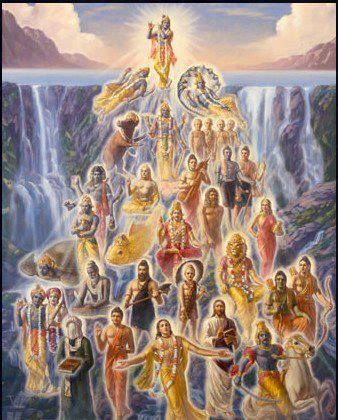
At the heart of the intricate and sublime theology of Vaiṣṇavism, particularly within the schools of Krishnaism such as Gauḍīya Vaiṣṇavism, lies a foundational principle that informs every other aspect of its philosophy: the position of Kṛṣṇa as the ultimate and original source of all divinity. This doctrine establishes a coherent and deeply personalistic monotheism, where the myriad forms of the divine are understood not as a disparate pantheon but as variegated manifestations of a single, supreme fountainhead. To comprehend the relationships between Kṛṣṇa’s various names, forms, and expansions, one must first grasp His unique ontological status as Svayam Bhagavān.
Section 1: The Doctrine of the Original Source (Avatārī)
Defining Svayam Bhagavān
The Sanskrit term Svayam Bhagavān translates literally as “God Himself” or “the Lord Himself”.1 Within the theological lexicon of Gauḍīya Vaiṣṇavism, the Nimbārka Sampradāya, and the Vallabha Sampradāya, it carries a precise and profound meaning: Kṛṣṇa is the primeval Lord, the original Personality of Godhead, who is the source of all
avatāras (incarnations), including the various forms of Viṣṇu and Nārāyaṇa.1 This concept distinguishes Kṛṣṇa from being merely an incarnation (
avatāra) and establishes Him as the avatārī—the source of all incarnations.4 He is the absolute and ultimate representation of Bhagavān, the Supreme Person, complete with all opulences.1
The Pivotal Declaration – kṛṣṇas tu bhagavān svayam
The scriptural cornerstone for this doctrine is a single, powerful verse from the Śrīmad-Bhāgavatam (1.3.28), which follows a list of various incarnations of the Lord:
ete caˉm˙sˊa-kalaˉḥ pum˙saḥ kṛṣṇas tu bhagavaˉn svayamindraˉri-vyaˉkulam˙ lokam˙ mṛḍayanti yuge yuge
“All of the incarnations listed previously are either plenary portions (aṁśa) or portions of the plenary portions (kalāḥ) of the Supreme Person (Puruṣa). However, Śrī Kṛṣṇa is Svayam Bhagavān, the original Supreme Personality of Godhead”.6
For Gauḍīya Vaiṣṇavas, this statement is not merely descriptive; it is a paribhāṣā-sūtra, a definitive, overriding rule that governs the interpretation of the entire Bhāgavatam and other related scriptures.7 It serves as a hermeneutical key, unlocking a specific theological structure where Kṛṣṇa is unequivocally placed at the apex of the divine hierarchy.
Śrīla Jīva Gosvāmī’s Exegesis
The most authoritative and detailed analysis of this verse comes from the 16th-century philosopher-saint Śrīla Jīva Gosvāmī in his monumental work, the Ṣaṭ-sandarbhas, specifically within the Kṛṣṇa-sandarbha.7 Jīva Gosvāmī’s exegesis provides the logical and grammatical foundation for the Gauḍīya understanding. He meticulously dissects the Sanskrit to reveal its unambiguous meaning:
- The Significance of
tu(“but”): He argues that the particletuis used to create a clear distinction. It separates the subject, Kṛṣṇa, from the previously mentioned list ofaṁśasandkalāḥ. This indicates that Kṛṣṇa is not in the same category as the other incarnations; He is qualitatively different and superior.7 - The Significance of
svayam(“Himself”): The wordsvayamemphasizes Kṛṣṇa’s originality and independence. It signifies that He is not anavatāraof some other form of Bhagavān but is Bhagavān in His own intrinsic, primeval identity.7 He is the source, not an emanation.
Jīva Gosvāmī concludes that while Kṛṣṇa was listed earlier as the twentieth incarnation, this verse provides the crucial, clarifying information about His supreme status, revealing Him as the source of the Puruṣa-avatāras themselves.7
Contrasting Interpretations (Madhvācārya)
This interpretation, while central to Gauḍīya thought, is not universally accepted across all Vaiṣṇava schools. Śrī Madhvācārya, the proponent of the Dvaita school of Vedānta, and his followers offer a different reading.7 They interpret the verse as a single sentence and make two critical changes:
- Reading
cāṁśaassvāṁśa: They read the phraseete cāṁśa-kalāḥasete svāṁśa-kalāḥ, changing “these portions” to “these self-same portions”.7 - Interpreting
tuaseva: They take the wordtuto meaneva(“indeed” or “only”), rather than “but”.7
This leads to a translation such as: “All these self-same portions (svāṁśa-kalāḥ) of the Puruṣa are indeed the Supreme Puruṣa Bhagavān Himself (kṛṣṇas tu bhagavān svayam), who gladdens the world…”.7 In this view,
kṛṣṇaḥ is interpreted not as the specific individual, Kṛṣṇa, but as a general term for the “Supreme Puruṣa,” and the verse collectively glorifies all the listed incarnations as being fully divine.
Jīva Gosvāmī was aware of and refuted this interpretation, arguing that it renders parts of the verse superfluous and ignores the clear disjunctive function of tu.7 This theological divergence is fundamental. Accepting Madhva’s reading positions Kṛṣṇa as one of many co-equal manifestations of a higher principle, typically Viṣṇu or Nārāyaṇa. Accepting Jīva Gosvāmī’s reading, however, establishes Kṛṣṇa as the supreme source of all, including Viṣṇu. This single verse, therefore, acts as a theological fork in the road, with the chosen path determining the entire structure of one’s understanding of the Godhead.
Supporting Scriptural Evidence
The Gauḍīya conclusion is further supported by other key scriptures. In the Bhagavad-gītā (7.7), Kṛṣṇa Himself declares, mattaḥ parataraṁ nānyat kiñcid asti dhanañjaya—”O conqueror of wealth, there is no truth superior to Me”.1 Similarly, the
Brahma-saṁhitā (5.1) begins with the definitive statement: īśvaraḥ paramaḥ kṛṣṇaḥ sac-cid-ānanda-vigrahaḥ anādir ādir govindaḥ sarva-kāraṇa-kāraṇam—”Kṛṣṇa, who is known as Govinda, is the Supreme Godhead. He has an eternal, blissful, spiritual body. He is the origin of all. He has no other origin, and He is the prime cause of all causes”.10 These texts, along with the
Gopāla Tāpanī Upaniṣad and others, form a cohesive scriptural basis for the doctrine of Kṛṣṇa as Svayam Bhagavān.2
Section 2: The Nature of the Supreme Form
Sac-cid-ānanda-vigraha – The Form of Eternity, Knowledge, and Bliss
The nature of Kṛṣṇa’s form is central to Vaiṣṇava theology. It is described as a sac-cid-ānanda-vigraha.11 This Sanskrit compound defines His body as being composed of three transcendental qualities:
Sat(Eternity): His form is eternal, unchanging, and ever-existing, beyond the influence of time and space. It is not a material body subject to birth, decay, and death.13Cit(Knowledge/Consciousness): His form is fully conscious and omniscient. He is the source of all knowledge and has nothing to learn from anyone.12Ānanda(Bliss): He is the reservoir of all pleasure and divine bliss. This is not the fleeting happiness of the material world but an infinite, transcendental joy.12
This spiritual form (vigraha) fundamentally distinguishes the Vaiṣṇava conception of God from impersonal (nirākāra) conceptions of Brahman, which may accept sat and cit but often neglect the personal, blissful (ānanda) feature of the Absolute Truth.13 The realization of Brahman is considered an incomplete understanding of the Absolute, which finds its full expression in the personal form of Kṛṣṇa.13
Hlādinī Śakti – The Potency of Bliss (Śrīmatī Rādhārāṇī)
The ānanda aspect of Kṛṣṇa’s being is not static; it is a dynamic, personified energy known as His internal pleasure potency, or Hlādinī Śakti.17 This potency, which is responsible for both Kṛṣṇa’s own bliss and the bliss He bestows upon His devotees, is fully embodied by His eternal consort, Śrīmatī Rādhārāṇī.17
Theologically, Rādhā and Kṛṣṇa are non-different (abheda). She is the energy (śakti), and He is the energetic (śaktimān). Just as the sun’s energy (sunshine) cannot be separated from the sun, Rādhārāṇī cannot be separated from Kṛṣṇa.17 Yet, for the purpose of relishing the dynamics of divine love (
prema-rasa), the one Absolute Truth manifests as two. Rādhārāṇī represents the supreme devotee and the ultimate reservoir of love for Kṛṣṇa. It is through Her that the highest levels of spiritual bliss are exchanged and experienced. She is therefore known as the “mistress” of His bliss, for without Her, the ānanda potency of Kṛṣṇa remains unmanifested and His desire for loving reciprocation remains unfulfilled.18
Kṛṣṇa’s Relationship with the Material World (Prakṛti)
While Kṛṣṇa’s form and abode are purely spiritual, He is the ultimate source and controller of the material energy, known as prakṛti or māyā.6 From the Vaiṣṇava perspective, the material world is a temporary, limited, and often bewildering manifestation of His external energy.20 Kṛṣṇa Himself, in His original form, remains completely transcendental to the material world and its three modes (
guṇas) of goodness, passion, and ignorance. He interacts with and manages the material creation not directly, but through His various expansions and potencies, such as the Puruṣa-avatāras. This allows Him to remain aloof, ever-absorbed in His eternal pastimes in the spiritual realm, without being touched or contaminated by material nature.21
Part II: The Taxonomy of Divine Expansions
From the singular fountainhead of Svayam Bhagavān Śrī Kṛṣṇa flows a systematic and hierarchical series of divine expansions. This taxonomy is not a random collection of deities but a highly organized structure that reveals a cosmos governed by purpose and order. Each expansion has a specific role in the administration and pastimes of the spiritual and material worlds.
Section 3: The Primary Expansions – The Catur-vyūha Doctrine
The Original Quadruple Expansion
The first and most immediate expansions from Kṛṣṇa are known as the Catur-vyūha, or the original quadruple expansion. These are four direct, personal expansions of the Godhead who preside over different cosmic functions.24 They are:
- Vāsudeva
- Saṅkarṣaṇa
- Pradyumna
- Aniruddha
These four forms are central to Pāñcarātrika theology and are considered the primary manifestations from which further expansions proceed.21
Cosmological Functions
The Catur-vyūha are associated with various cosmic and psychological functions. In one schema, Vāsudeva presides over consciousness, Saṅkarṣaṇa over the ego (ahaṅkāra), Pradyumna over the intelligence (buddhi) and mind (manas), and Aniruddha over the senses.27 In another, more macrocosmic context, they are linked to the universal functions of creation, maintenance, and destruction. For instance, Vāsudeva is sometimes identified with creation, Saṅkarṣaṇa with sustenance, and Pradyumna with dissolution.25 These expansions are worshiped as the divine structure of spiritual existence, embodying unity in diversity.24
Historical Evolution from the Vṛṣṇi Heroes
The Catur-vyūha doctrine has deep historical roots, evolving from the ancient worship of the Vṛṣṇi heroes in the region of Mathura around the 4th century BCE.26 Initially, these heroes—Saṃkarṣaṇa (Balarāma), Vāsudeva (Kṛṣṇa), Pradyumna (Kṛṣṇa’s son), Samba (Kṛṣṇa’s son), and Aniruddha (Kṛṣṇa’s grandson)—were revered as deified historical or legendary figures.26
Archaeological and numismatic evidence charts their gradual assimilation into mainstream Vaiṣṇavism. Coins from the Indo-Greek king Agathocles (c. 185-170 BCE) depict Vāsudeva-Kṛṣṇa holding a conch and chakra, and Balarāma-Saṃkarṣaṇa holding a plough and pestle, indicating their established deified status.26 In these early depictions, Saṃkarṣaṇa often appears to hold a senior position.28 Inscriptions like the Ghosundi inscription from the 1st century BCE further confirm the worship of Saṃkarṣaṇa and Vāsudeva together, linking them with the supreme deity Nārāyaṇa.29 By the end of the Kushan period (c. 2nd century CE), these heroes (with the exception of Samba) were fully integrated into the
Vyūhavāda (doctrine of emanations), becoming the four primary expansions of Viṣṇu.26 This historical progression shows a synthesis of local hero-cults with the broader Vaiṣṇava framework.
Section 4: Baladeva – The First Servitor Expansion
Identity as Saṅkarṣaṇa
Lord Baladeva, also known as Balarāma, is Kṛṣṇa’s elder brother and His first personal expansion.22 In the theological hierarchy, He is non-different from Kṛṣṇa but exists eternally in the mood of a servitor. He is identified with Saṅkarṣaṇa, the second member of the original
Catur-vyūha.21 As Saṅkarṣaṇa, He is the “plougher” and the predominator of the creative energy and the individual living entity (
jīva).21 His name Saṅkarṣaṇa also refers to his ability to attract all living beings to the service of the Lord.28
Role in Creation
Baladeva’s role in creation is pivotal and twofold. By the will of Kṛṣṇa, Baladeva, in His form as Saṅkarṣaṇa, is the direct cause of the entire spiritual world. He creates the eternal planets of Goloka Vṛndāvana and the unlimited Vaikuṇṭha realms, which are sustained by His pure spiritual energy (śuddha-sattva).21
For the creation of the material worlds, He expands Himself as Mahā-Saṅkarṣaṇa. It is from Mahā-Saṅkarṣaṇa that Mahā-Viṣṇu (also known as Kāraṇodakaśāyī Viṣṇu) emanates. Mahā-Viṣṇu lies within the Causal Ocean (Kāraṇa-sāgara) and, by glancing upon the material energy (prakṛti), impregnates it with the seeds of countless universes, which emanate from the pores of His skin with His every exhalation.10 This establishes Baladeva as the immediate source of both the spiritual and material creations, acting always in service to Kṛṣṇa’s will.
Manifestation as Ananta-Śeṣa
To facilitate the Lord’s pastimes and rest, Baladeva expands into the form of the great serpent Ananta-Śeṣa (or Śeṣanāga). In this form, He serves as the divine couch upon which Mahā-Viṣṇu and Garbhodakaśāyī Viṣṇu recline.21 With his unlimited hoods, he holds the planetary systems and constantly sings the glories of the Lord. Ananta-Śeṣa embodies the perfect mood of a devotee, knowing nothing but the service of Kṛṣṇa.21
Section 5: A Comprehensive Typology of Avatāras
Definition of Avatāra
The term avatāra literally means “one who descends”.32 In Vaiṣṇava theology, it specifically refers to a form of the Lord who descends from the spiritual sky into the material cosmos for a particular mission, most often to protect the righteous, annihilate miscreants, and re-establish the principles of religion (
dharma).10 While there are innumerable
avatāras, Gauḍīya Vaiṣṇava texts, drawing from scriptures like the Śrīmad-Bhāgavatam, classify them into six primary categories.10 This systematic classification reveals a universe that is not chaotic but is a cosmos governed by divine order and purpose. Every manifestation of God has a specific function, time, and place within a grand, structured plan emanating from Kṛṣṇa, the
avatārī.
The Six Categories of Incarnations
Puruṣa-avatāras(The Cosmic Viṣṇus): These are the three primary Viṣṇu expansions who preside over the creation and maintenance of the material universes. They are the first descents into the material realm.10- Kāraṇodakaśāyī Viṣṇu (Mahā-Viṣṇu): The first
Puruṣa, who lies in the Causal Ocean. From His breath, innumerable universes are born.10 - Garbhodakaśāyī Viṣṇu: The second
Puruṣa, who enters each individual universe. From His navel sprouts the lotus upon which Lord Brahmā, the secondary creator, is born.10 - Kṣīrodakaśāyī Viṣṇu: The third
Puruṣa, who resides on an ocean of milk within each universe and expands as the Paramātmā, or Supersoul, in the heart of every living being.10 He is also the source of thelīlā-avatāras.
- Kāraṇodakaśāyī Viṣṇu (Mahā-Viṣṇu): The first
Guṇa-avatāras(Qualitative Incarnations): These are the deities who control the three modes (guṇas) of material nature to manage the universe’s functions.10- Brahmā: Controls the mode of passion (
rajo-guṇa) and is responsible for secondary creation. - Viṣṇu (Kṣīrodakaśāyī): Controls the mode of goodness (
sattva-guṇa) and is responsible for maintenance and preservation. - Śiva: Controls the mode of ignorance (
tamo-guṇa) and is responsible for cosmic annihilation.
- Brahmā: Controls the mode of passion (
Līlā-avatāras(Pastime Incarnations): These are the most well-knownavatāraswho descend to perform specific transcendental pastimes (līlās). The Śrīmad-Bhāgavatam lists twenty-five principallīlā-avatāras, including 10:- The Four Kumāras: Sons of Brahmā who appear as children to teach transcendental knowledge.
- Nārada Muni: The great sage who travels the cosmos spreading devotional service.
- Varāha: The boar incarnation who lifted the Earth from the cosmic ocean.
- Matsya: The fish incarnation who saved the sage Satyavrata from a universal flood.
- Kūrma: The tortoise incarnation who supported the Mandara mountain during the churning of the ocean of milk.
- Nṛsiṁha: The half-man, half-lion incarnation who protected His devotee Prahlāda.
- Vāmana: The dwarf-brāhmaṇa incarnation who reclaimed the universe from King Bali.
- Paraśurāma: The warrior incarnation who rid the earth of corrupt kings.
- Rāmacandra: The ideal king who vanquished the demon Rāvaṇa.
- Kṛṣṇa and Balarāma: Listed here as well, before Kṛṣṇa’s supreme position is clarified.
- Buddha: An incarnation who appeared to mislead the atheistic and stop animal sacrifice.
- Kalki: The prophesied incarnation who will appear at the end of the Kali-yuga.
Manvantara-avatāras: These incarnations appear within eachmanvantara(the lifespan of a Manu, a period of approximately 306.72 million years) to assist the demigods and guide humanity. There are fourteen suchavatārasin one day of Brahmā, including figures like Yajña, Vibhu, and Satyasena.10Yuga-avatāras: These incarnations descend in each of the four cosmic ages (yugas) to establish theyuga-dharma, the specific religious process for that age.10 They are distinguished by their color: white in Satya-yuga, red in Tretā-yuga, blackish (kṛṣṇa) in Dvāpara-yuga, and yellow (as Lord Caitanya) in Kali-yuga.10Śaktyāveśa-avatāras(Empowered Incarnations): These are not direct descents of the Lord but are powerful living entities (jīvas) who are specifically empowered (āveśa) by the Lord with a portion of His potency (śakti) to carry out a special mission.10 Examples include Nārada Muni (empowered withbhakti-śakti), the four Kumāras (jñāna-śakti), King Pṛthu (pālana-śakti, ruling power), and Paraśurāma (duṣṭa-damana-śakti, power to vanquish evil).
This elaborate system demonstrates a universe infused with divine purpose at every level, from the creation of the cosmos to the empowerment of individual souls for specific tasks, all originating from and orchestrated by Svayam Bhagavān Śrī Kṛṣṇa.
Part III: The Spectrum of Divine Moods and Forms (Rasa and Rūpa)
Beyond the structural hierarchy of expansions, Vaiṣṇava theology explores the qualitative differences between Kṛṣṇa’s manifestations. These differences are understood through the concept of rasa—the specific transcendental flavor or mood of the loving relationship between the Lord and His devotees. The two primary rasas that define Kṛṣṇa’s pastimes are mādhuryā (sweetness) and aiśvarya (majesty).
Section 6: The Dichotomy of Divine Mood – Mādhuryā vs. Aiśvarya
Defining the Moods
Aiśvarya refers to a mood of devotion characterized by awe and reverence for the Lord’s supreme power, majesty, and opulence.35 In this mood, the devotee is always conscious of Kṛṣṇa’s position as God, the supreme controller. This relationship is formal and respectful.
Mādhuryā, in contrast, is a mood of intimate, sweet, and spontaneous love.35 In
mādhuryā-rasa, the Lord’s overwhelming divinity is veiled by the intensity of the personal relationship. The devotee interacts with Kṛṣṇa as a friend, a child, or a lover, forgetting that He is the Supreme Lord. This mood is characterized by its human-like (nara-līlā) quality, where intimacy eclipses power.35
Yāśodā Kṛṣṇa (Vṛndāvana): The Epitome of Mādhuryā
The original form of Kṛṣṇa in Vṛndāvana, known as Yāśodā-nandana (the son of Yāśodā) or Nanda-kumāra (the son of Nanda), is the supreme embodiment of mādhuryā.11 His life in the pastoral village of Vṛndāvana is filled with charming, human-like pastimes: stealing butter, playing with His cowherd friends, and engaging in loving exchanges with the
gopīs.11
The defining feature of Vṛndāvana is that mādhuryā completely overpowers aiśvarya. Even when Kṛṣṇa performs astounding miracles, such as lifting Govardhana Hill or killing powerful demons, His intimate associates do not perceive Him as God.35 Mother Yāśodā, seeing Him lift a mountain, still worries that her little boy must be tired and hungry.35 His friends wrestle with Him, climb on His shoulders, and treat Him as an equal.36 This forgetfulness of His divinity is not ignorance but a product of the highest form of love (
prema), which seeks intimacy above all else. Vṛndāvana is the realm where love is supreme.40
Vāsudeva Kṛṣṇa (Mathurā/Dvārakā): The Realm of Aiśvarya
When Kṛṣṇa leaves Vṛndāvana and enters the cities of Mathurā and Dvārakā, His mood and pastimes shift to aiśvarya.40 Here, He is Vāsudeva-putra, the son of the prince Vasudeva and Devakī, and He plays the role of a royal prince and later a majestic king, Dvārakādhīśa.39 His life is characterized by opulence, grandeur, and formality. He rules over a magnificent city with 16,108 palaces for His queens, engages in statecraft, and is worshiped with pomp and reverence.40
In Dvārakā, His devotees, including His queens like Rukmiṇī and Satyabhāmā, are always aware of His divine identity.45 Their love, though profound, is tinged with the awe and veneration befitting a relationship with the Supreme Lord. This mood is more akin to the worship of Viṣṇu in the Vaikuṇṭha planets.40
Theological Distinction
Gauḍīya Vaiṣṇava theology makes a crucial distinction: the Kṛṣṇa of Vṛndāvana is the original, svayam-rūpa form of the Godhead, who, in a mystical sense, never leaves Vṛndāvana (vṛndāvanaṁ parityajya pādam ekaṁ na gacchati).39 The forms that appear in Mathurā and Dvārakā are considered His plenary portions or
vilāsa expansions. These expansions are fully God, but they manifest more of the aiśvarya (majesty) feature and less of the mādhuryā (sweetness) feature that is the unique characteristic of the original Kṛṣṇa in Vṛndāvana.39
Section 7: The Three Presiding Deities of Vṛndāvana
Within the sacred geography of Vṛndāvana, three principal Deities are revered by Gauḍīya Vaiṣṇavas as the “life and soul” of their tradition.48 These Deities—Śrī Madana-mohana, Śrī Govinda-deva, and Śrī Gopīnātha—are not merely representations of Kṛṣṇa but are worshiped as presiding over the three essential stages of a devotee’s spiritual journey:
sambandha, abhidheya, and prayojana.48
- Śrī Madana-mohana (Sambandha – Relationship):Madana-mohana, whose name means “one who enchants even Cupid,” is the presiding Deity of sambandha-jñāna—the initial stage of re-establishing one’s forgotten relationship with Kṛṣṇa.48 His irresistible charm attracts the neophyte devotee, pulling them away from material attachments and toward the spiritual path.50 The worship of this Deity was established by the great ācārya Śrīla Sanātana Gosvāmī.50 The Deity was originally discovered by Advaita Ācārya and later entrusted to Sanātana Gosvāmī after Madana-mohana Himself appeared in a dream to the brāhmaṇa who was caring for Him, instructing him to do so. Sanātana Gosvāmī’s humble worship—offering only dry, coarse bread—attracted the patronage of a wealthy merchant, Krishnadas Kapoor, who, after being saved from a shipwreck by the Deity’s grace, financed the construction of the magnificent Madan-mohan temple, the first in Vṛndāvana.53
- Śrī Govinda-deva (Abhidheya – Process):Govinda-deva, “one who pleases the cows, the land, and the senses,” is the presiding Deity of abhidheya—the active process of devotional service (bhakti-yoga) that one performs after understanding their relationship with the Lord.48 Worship of Govinda-deva represents the stage of dedicated service and action. His worship was established by Śrīla Rūpa Gosvāmī, the foremost disciple of Śrī Caitanya Mahāprabhu.48 The Deity was discovered after Rūpa Gosvāmī, lamenting his inability to find the lost Deity, was approached by a beautiful Vrajavāsī boy (Kṛṣṇa Himself in disguise) who directed him to a hillock called Goma-ṭīlā. There, a cow would daily offer her milk into a hole in the ground. Upon excavation, the beautiful form of Govinda-deva was revealed.51 The famous
Jhūlana-yātrā(swing festival) is a prominent pastime associated with Śrī Govinda-deva, where He and Rādhārāṇī are lovingly swung by thegopīsin a display of intimate service.59 - Śrī Gopīnātha (Prayojana – Goal):Gopīnātha, also known as Gopījana-vallabha (“the beloved of the gopīs”), is the presiding Deity of prayojana—the ultimate goal of life, which is the attainment of pure, unadulterated love of Godhead (prema-bhakti).48 He represents the perfection of devotion, where the devotee is fully absorbed in selfless, loving exchanges. His worship was established by Madhu Paṇḍita, a disciple of Gadādhara Paṇḍita.50 The Deity was discovered at Vaṁśī-vaṭa, the sacred spot on the bank of the Yamunā where Kṛṣṇa played His flute to call the
gopīsfor therāsa-līlā.61 A famous pastime associated with Gopīnātha involves Jāhnavā Devī (the consort of Lord Nityānanda), who, duringārati, was miraculously drawn onto the altar by the Deity and merged into His form.61
The progression of worship from Madana-mohana to Govinda-deva to Gopīnātha maps the devotee’s internal journey: from initial attraction and the establishment of a relationship, to the dedicated practice of service, and finally to the supreme attainment of ecstatic, selfless love.
Section 8: The Enigmatic Triad of Jagannātha Purī
The deities of Jagannātha (“Lord of the Universe”), Baladeva, and their sister Subhadrā, housed in the great temple at Purī, present one of the most unique and complex iconographic traditions in Hinduism. While deeply integrated into Vaiṣṇavism, their forms and worship reveal a rich history of syncretism.
Vaiṣṇava Origin from Skanda Purāṇa
The primary Vaiṣṇava narrative for the origin of the deities is found in the Utkala-khaṇḍa of the Skanda Purāṇa.63 It tells of a pious king named Indradyumna who, after dreaming of a beautiful blue deity named Nīla Mādhava, sent messengers to find Him. The deity was being secretly worshiped by a tribal chief named Viśvāvasu. By the time the king arrived, Nīla Mādhava had disappeared. A divine voice then instructed the king to build a temple and that the Lord would appear in a form made of
dāru (wood).63 A massive log washed ashore, and Viśvakarmā, the architect of the gods, appeared as an old carpenter to carve the deities, on the condition that he not be disturbed for twenty-one days. Impatient, the king opened the doors early, and Viśvakarmā vanished, leaving the deities “unfinished”—with large, round eyes, no discernible limbs, and stump-like bodies.63 Lord Jagannātha later appeared in a dream to reassure the king, explaining that this form was His own inconceivable desire, to show that He can move without feet and accept offerings without hands.63
Theological Explanation – Mahābhāva-prakāśa
The peculiar, non-anthropomorphic forms of the triad are given a profound theological explanation within Gauḍīya Vaiṣṇavism. They are seen as mahābhāva-prakāśa—the external manifestation of the highest state of spiritual ecstasy (mahābhāva).63 The story relates that once in Dvārakā, Kṛṣṇa, Balarāma, and Subhadrā stood outside a room where Rohiṇī-devī was narrating Kṛṣṇa’s intimate and heart-rending Vṛndāvana pastimes. Overhearing these narrations, the three became overwhelmed with ecstatic love and separation. Their limbs retracted into their bodies, their heads compressed, and their eyes grew wide with divine emotion. Thus, the forms of Jagannātha, Baladeva, and Subhadrā represent Kṛṣṇa and His siblings absorbed in the highest ecstasy of love in separation from their Vṛndāvana devotees.63
Syncretic Influences (Tribal and Śākta)
The Jagannātha cult is a powerful example of how a major religious tradition assimilates and reinterprets potent local beliefs. The Vaiṣṇava narrative provides a sophisticated theological framework, but it does so while incorporating pre-existing elements, pointing to a syncretic origin.
- Tribal Influence: Strong evidence links the cult to the indigenous tribal traditions of Odisha, particularly the Śabara tribe.65 The use of wood (
dāru-brahma) for the deities, their non-naturalistic forms, and the central role of tribal priests known asdaitāpatis(who are considered descendants of the original tribal worshiper Viśvāvasu and perform the most intimate services, including the transfer of thebrahma-padārthaduring theNavakalevaraceremony) all point to tribal roots.64 Some scholars suggest the iconography evolved from the worship of wooden posts or pillars (stambha), such as the goddess Stambheśvarī or Khambeśvarī, who was revered by local tribes.64 - Śākta Influence: The Purī temple is also recognized as a major
Śakti-pīṭha, where the navel of the goddess Satī is said to have fallen. The goddess Vimalā is the presidingśaktiof thepīṭha, and tantric traditions identify Jagannātha as the Bhairava (a fierce form of Śiva) to Vimalā’s Śakti.64 Significantly, the food offered to Jagannātha only becomesmahāprasāda(great sanctified food) after it is first offered to Vimalā.65 The central placement of Subhadrā between her two brothers is also highly unusual and points to the importance of the feminine principle. She is often identified with Śakti, Durgā, or as the personification of Yogamāyā, the Lord’s internal spiritual energy.64
This process of assimilation demonstrates theology as a dynamic tool for cultural and religious integration. By creating a Puranic narrative (King Indradyumna), providing a profound theological explanation for the unique forms (mahābhāva), and incorporating existing priests and rituals, Vaiṣṇavism was able to absorb a powerful local cult and elevate it to a pan-Hindu status as the “Lord of the Universe.”
Part IV: The Reciprocation of Love – Kṛṣṇa and His Devotees
The theology surrounding Kṛṣṇa is not merely an abstract description of the divine but is fundamentally about rasa—the loving relationships reciprocated between the Lord and His devotees. The infinite variety of Kṛṣṇa’s forms and pastimes exists to facilitate this limitless spectrum of devotional moods.
Section 9: The Apex of Devotion – The Gopīs of Vṛndāvana
Madhurya-rasa and Selfless Love (Prema)
The gopīs, the cowherd damsels of Vṛndāvana, are universally exalted in Gauḍīya Vaiṣṇavism as the paramount examples of pure devotion.68 They embody the highest and most intimate devotional mellow,
madhurya-rasa (transcendental conjugal love).37 Their love (
prema) is defined by its absolute selflessness. Their every thought, word, and action is directed solely towards Kṛṣṇa’s pleasure, with no trace of desire for their own happiness, social standing, religious piety, or even personal salvation.68 When asked to provide dust from their feet to cure Kṛṣṇa’s supposed headache—an act that would condemn them to hell according to religious convention—they did not hesitate, reasoning that an eternity in hell was a small price to pay for a moment of their beloved’s relief.70
The Rāsa-līlā
The quintessential pastime of madhurya-rasa is the Rāsa-līlā, the divine circle dance performed on a full-moon autumn night.73 Upon hearing the enchanting sound of Kṛṣṇa’s flute, the
gopīs abandoned their homes, husbands, and children—all their prescribed worldly duties—to rush to the forest to be with Him.68 To reciprocate with their pure love, Kṛṣṇa miraculously expanded Himself into numerous forms, so that each
gopī felt that she was dancing with Him alone.68 This pastime is not to be mistaken for mundane lust; it is a sacred, spiritual exchange symbolizing the intense and singular longing of the individual soul (
jīva) for union with the Supreme Soul (Paramātmā).73
Parakīya-bhāva – The Paramour Mood
The gopīs' love for Kṛṣṇa is theologically classified as parakīya-bhāva, or the mood of a paramour, as many of them were ostensibly married to other cowherds.37 In the context of the spiritual world, this is considered the highest and most intense form of love. It signifies a love so powerful that it willingly transgresses all other social and religious obligations (
dharma) for the sake of the beloved. This represents the ultimate act of surrender, placing love for Kṛṣṇa above every other consideration.37 This is contrasted with
svakīya-bhāva, the mood of married love, which characterizes the relationship between Kṛṣṇa and His queens in the opulent setting of Dvārakā.37
Section 10: The Spectrum of Devotional Relationships
While madhurya-rasa is the apex, Vaiṣṇavism recognizes a spectrum of valid and beautiful loving relationships with Kṛṣṇa.
Arjuna – Sakhya-rasa (Friendship)
The relationship between Kṛṣṇa and the Pāṇḍava prince Arjuna is the preeminent example of sakhya-rasa, or love in friendship.79 They are cousins and intimate companions. However, their friendship is categorized as
aiśvarya-miśra-sakhya—friendship mixed with an awareness of Kṛṣṇa’s divinity.82 This is most evident during the
Bhagavad-gītā, when Arjuna, after witnessing Kṛṣṇa’s awe-inspiring universal form (viśvarūpa), begs forgiveness for having treated Him informally as a friend.79 This mood is distinct from the pure, uninhibited friendship of the Vṛndāvana cowherd boys like Śrīdāmā and Sudāmā, who wrestle with Kṛṣṇa and ride on His shoulders, completely oblivious to His godhood.82
Uddhava – Intimate Friend and Messenger
Uddhava holds a unique position as Kṛṣṇa’s cousin, dear friend, and trusted counselor.84 He is a disciple of Bṛhaspati and a minister to the Vṛṣṇis, and his physical appearance was so similar to Kṛṣṇa’s that he was sometimes mistaken for Him.84 Uddhava’s most significant role occurs when Kṛṣṇa sends him to Vṛndāvana as a messenger to console the
gopīs. There, Uddhava is so profoundly moved by the depth of their selfless love that he prays to be born as a humble blade of grass in Vṛndāvana, so that he might be sanctified by the dust of their feet.84 Before His departure from the world, Kṛṣṇa imparts His final and most confidential instructions to Uddhava, a dialogue known as the
Uddhava-gītā.84
Nārada Muni – The Divine Catalyst
Nārada Muni is a śaktyāveśa-avatāra, a pure devotee empowered with bhakti-śakti to travel the cosmos and propagate the glories of the Lord.85 He often acts as a divine catalyst in Kṛṣṇa’s pastimes. It was Nārada who informed the tyrant Kaṁsa of his impending death at the hands of Devakī’s eighth son, thus expediting the events leading to Kṛṣṇa’s appearance.85 He visited Dvārakā to witness and glorify Kṛṣṇa’s opulent pastimes with His 16,108 queens, confirming the Lord’s divine nature for all to hear.86 It was also Nārada’s prayer to see Kṛṣṇa’s ecstatic form that led to the Lord’s promise to manifest as Jagannātha in Purī.63 His role is to facilitate and broadcast the Lord’s
līlā.
Other Notable Devotees
The tapestry of devotion to Kṛṣṇa is vast and includes countless other figures who exemplify different facets of love. The Pāṇḍava brothers demonstrate unwavering loyalty and friendship. Dhruva Mahārāja, as a five-year-old boy, performed severe austerities and attained a vision of the Lord.90
Prahlāda Mahārāja maintained his devotion even in the face of persecution from his demonic father.91 In more recent history, saints like the 16th-century princess
Mīrābāī expressed their love through devotional poetry.92
Śrī Caitanya Mahāprabhu, who is understood to be Kṛṣṇa Himself in the mood of Rādhārāṇī, appeared in the 15th century to teach the path of congregational chanting (saṅkīrtana).92 His principal followers, the
Six Gosvāmīs of Vṛndāvana (including Rūpa and Sanātana), systematically excavated the lost holy places and codified the theology of prema-bhakti for future generations.93
Part V: Lexicon and Concluding Synthesis
To consolidate the vast theological landscape explored, this final part provides a practical lexicon of Kṛṣṇa’s names and a synthesis of the report’s central themes, illustrating the profound unity that underlies the divine diversity.
Section 11: A Comprehensive Glossary of Kṛṣṇa’s Names
Kṛṣṇa’s names are not mere labels but are sonic manifestations of His qualities, pastimes, and relationships. A categorized understanding of His names provides a deeper insight into His multifaceted personality. The following table organizes a selection of His prominent names according to the context and devotional mood they evoke.
| Name (IAST) | Literal Meaning | Associated Pastime / Quality | Primary Rasa / Context |
| Kṛṣṇa | The All-Attractive One | His fundamental nature; His dark, captivating complexion.11 | Svayam Bhagavān (Original Form) |
| Govinda | One who pleases the cows, land, and senses | Lifting Govardhana Hill; Tending cows in Vṛndāvana.11 | Mādhuryā (Sweetness) |
| Gopāla | Protector of Cows | Herding the cows with His friends in the pastures of Vṛndāvana.11 | Sakhya-rasa (Friendship) |
| Yaśodā-nandana | The Joy of Mother Yaśodā | His childhood pastimes as the beloved son of Mother Yaśodā.11 | Vātsalya-rasa (Parental Love) |
| Devakī-nandana | The Son of Devakī | His divine birth in the prison of Kaṁsa in Mathurā.11 | Aiśvarya (Divine Mission) |
| Dāmodara | One whose belly is bound by a rope | Being tied to a grinding mortar by Mother Yaśodā’s love.95 | Vātsalya-rasa (Mādhuryā-dominant) |
| Madan-mohana | One who enchants even Cupid | His supremely attractive form as the transcendental lover.11 | Madhurya-rasa (Conjugal Love) |
| Gopīnātha | The Lord/Master of the gopīs | Presiding over the Rāsa-līlā with His most intimate devotees.48 | Madhurya-rasa (Parakīya-bhāva) |
| Pārthasārathi | Charioteer of Pārtha (Arjuna) | Driving Arjuna’s chariot and speaking the Bhagavad-gītā.96 | Sakhya-rasa (Aiśvarya-mixed) |
| Dvārakādhīśa | The Lord/King of Dvārakā | Ruling as a majestic king in the opulent city of Dvārakā.11 | Aiśvarya (Majesty/Opulence) |
| Madhusūdana | Slayer of the demon Madhu | His role as the protector of the devotees by vanquishing evil forces.95 | Aiśvarya (Divine Power) |
| Achyuta | The Infallible One | His quality of never failing His devotees or swerving from His promises.95 | Transcendental Quality |
| Keśava | One with beautiful hair; Slayer of the demon Keśī | His captivating beauty and His power to destroy demons.95 | Mādhuryā and Aiśvarya |
| Hṛṣīkeśa | The Master of the Senses | His ability to control the minds and senses of all living beings.97 | Aiśvarya (Supreme Control) |
Section 12: Concluding Synthesis – The Unity in Diversity
This comprehensive exploration of Kṛṣṇa’s names, forms, and expansions reveals a theological system of immense depth and coherence. The central, unifying principle is that Śrī Kṛṣṇa, the charming cowherd boy of Vṛndāvana, is Svayam Bhagavān—the original, supreme Personality of Godhead and the single fountainhead of all divinity.1 The seemingly endless variety of His manifestations is not a contradiction or a sign of polytheism but is, in fact, the ultimate proof of His completeness.
From Him emanate the Catur-vyūha, the primary expansions who orchestrate cosmic affairs. From His first expansion, Baladeva, the spiritual and material worlds are created.21 From Him descend the innumerable
avatāras—the Puruṣas, Guṇas, Līlās, and others—each with a specific purpose within the divine plan.10 This structured taxonomy paints a picture of a cosmos that is meticulously ordered and permeated with divine purpose.
The qualitative differences among these forms are understood through the lens of rasa. The distinction between the aiśvarya (majesty) of Dvārakā and the mādhuryā (sweetness) of Vṛndāvana highlights the Lord’s capacity to engage in different kinds of loving relationships.35 While His power and opulence are limitless, He allows His divinity to be veiled by the intimacy of
prema in Vṛndāvana, which is considered the highest and most confidential realm of spiritual reality.
Ultimately, the entire divine structure exists to facilitate loving reciprocation with the individual souls (jīvas). The spectrum of relationships—from the reverential service of a servant, to the informal ease of a friend, the protective affection of a parent, and the all-consuming passion of a lover—provides a pathway for every soul to realize its unique and eternal connection with the Supreme. The spiritual journey, as mapped by Vaiṣṇava theology, is therefore a dynamic progression from a distant awareness of God’s power to an intimate, personal, and blissful participation in His life of love. The many names and forms of Kṛṣṇa are invitations, calling every soul back to this eternal, loving relationship.